
Pineal Guardian Review: Ingredients, Benefits, How It Works, Price & What to Know Before Buying
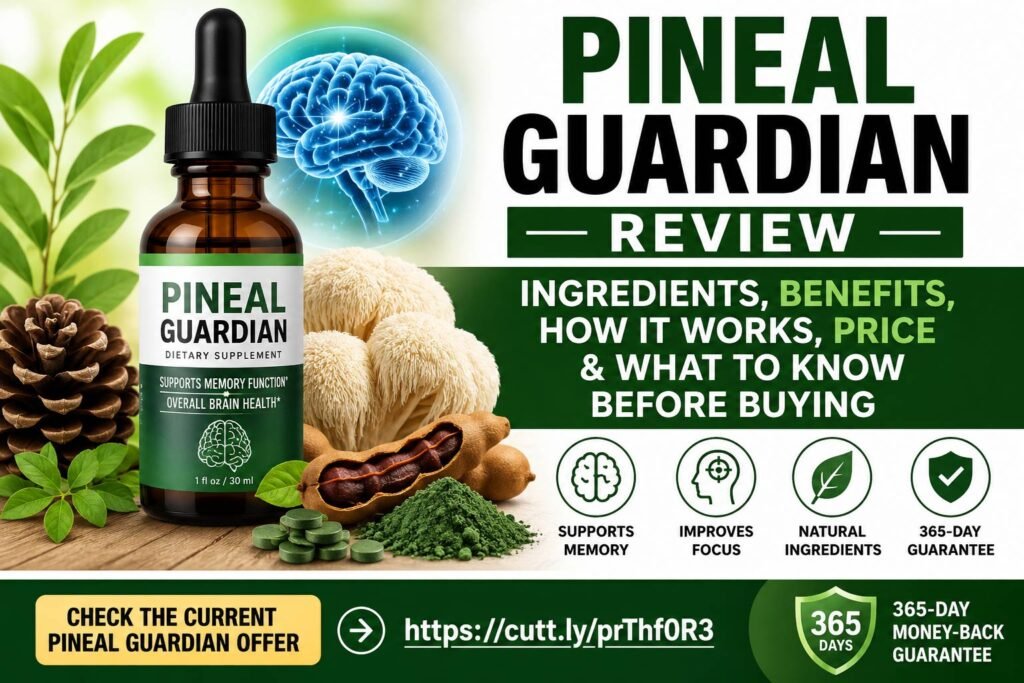
Pineal Guardian is a liquid dietary supplement marketed toward adults who are interested in memory support, mental clarity and overall brain health. If you’ve seen advertisements for Pineal Guardian and are now searching for a more detailed Pineal Guardian review, this guide looks at what the product is, what the manufacturer says about it, the ingredients listed on the current product page, pricing, the money-back guarantee, potential limitations and the questions worth asking before you buy.
Why Are People Looking at Brain Health Supplements?
Forgetting a name occasionally, losing your train of thought, feeling mentally tired after a long day or struggling to stay focused can be frustrating.
These experiences can have many possible causes, including stress, poor sleep, lifestyle factors, medications, normal aging and a wide range of medical conditions. That’s why a supplement should not be viewed as a replacement for medical evaluation when memory changes are significant or concerning.
At the same time, many adults are interested in nutritional approaches that may support normal cognitive function as part of a broader healthy lifestyle.
That’s where Pineal Guardian enters the conversation.
The product is marketed as a liquid brain-health supplement designed to support memory function and overall brain health. The current vendor page lists a plant-based formula containing ingredients such as pine bark extract, tamarind, chlorella, ginkgo biloba, spirulina, Lion’s Mane mushroom, Bacopa monnieri, moringa and neem.
But is Pineal Guardian worth considering?
Let’s take a closer look.
Quick Takeaways
- Pineal Guardian is marketed as a liquid dietary supplement.
- The current product page positions it around memory function and overall brain health.
- The listed formula includes nine highlighted ingredients on the current vendor page.
- The product is sold through a ClickBank checkout according to the vendor page.
- The current sales page advertises a 365-day money-back guarantee.
- Individual ingredient research should not be interpreted as proof that the finished Pineal Guardian formula produces the same results.
- Anyone taking medication or dealing with a medical condition should discuss the product with a qualified healthcare professional before use.
👉 Want to See the Current Pineal Guardian Offer?
If you’re interested in reviewing the current product information, availability and offer details, you can check the current offer here:
Check the Current Pineal Guardian Offer
What Is Pineal Guardian?
Pineal Guardian is presented as a liquid dietary supplement for memory and brain-health support.
Unlike traditional capsules or tablets, the current vendor page describes Pineal Guardian as a liquid/drop product. The manufacturer recommends one drop per day, preferably in the morning, and says it can be taken directly or mixed into a beverage.
The product’s marketing focuses on supporting normal memory function and overall brain health rather than presenting itself as a prescription medicine.
That distinction is important.
Pineal Guardian is a dietary supplement. It is not a substitute for diagnosis or treatment of Alzheimer’s disease, dementia, memory disorders or another medical condition.
The vendor itself states that the product’s claims have not been evaluated by the FDA and advises people with medical conditions or those taking prescription medication to consult a physician before use.
So when evaluating a Pineal Guardian review, it’s useful to separate three things:
- What the manufacturer claims.
- What research exists for individual ingredients.
- What has actually been demonstrated for the finished Pineal Guardian product.
Those three things aren’t necessarily identical.
How Does Pineal Guardian Work?
The brand’s overall concept is built around providing nutritional and botanical ingredients associated with brain and cognitive wellness.
The current vendor page says Pineal Guardian contains nine natural ingredients combined to support memory function and overall brain health.
A recent 2026 review discussing the product also makes an important distinction: research on individual ingredients does not establish that the finished Pineal Guardian formula will necessarily produce the same outcomes, particularly when the exact amounts of individual ingredients are not disclosed publicly.
That is an important point for any potential buyer.
For example, if an individual ingredient has been studied at a particular dose, you cannot automatically assume that a proprietary supplement containing that ingredient will provide the same effect.
The General Formula Approach
Pineal Guardian’s formula combines several categories of ingredients:
- Botanical extracts
- Mushrooms
- Algae
- Plant-based nutritional ingredients
- Traditional herbal ingredients
- Antioxidant-oriented compounds
The intention is to provide a broad nutritional approach rather than relying on one single ingredient.
Pineal Guardian Ingredients
The current vendor page lists the following nine highlighted ingredients:
- Pine Bark Extract
- Tamarind
- Chlorella
- Ginkgo Biloba
- Spirulina
- Lion’s Mane Mushroom
- Bacopa Monnieri
- Moringa
- Neem
Let’s look at them individually.
1. Pine Bark Extract
Pine bark extract is a botanical ingredient that has been researched for antioxidant and vascular-related properties.
The ingredient is interesting in the context of cognitive wellness because healthy circulation is an important part of normal brain function.
Research on pine bark extracts has investigated areas including circulation, oxidative stress and certain cognitive outcomes.
However, the evidence for an ingredient should not be confused with evidence for the entire Pineal Guardian formula.
A supplement containing pine bark extract isn’t automatically equivalent to a clinical study conducted using a standardized extract at a specific dose.
Key Point
Pine bark extract provides a reasonable botanical component for a formula focused on antioxidant and circulation-related support, but the specific effect of Pineal Guardian depends on the complete formulation, dose and individual response.
2. Tamarind
Tamarind is a fruit-derived botanical that has been used traditionally in different cultures.
It is particularly interesting because the Pineal Guardian marketing connects tamarind with its broader detoxification and pineal-gland narrative.
Some research has investigated tamarind and fluoride excretion, particularly in populations exposed to higher levels of naturally occurring fluoride.
However, that research should not be stretched into a claim that taking tamarind in a supplement will “clean” or “decalcify” the pineal gland.
A 2026 analysis of Pineal Guardian specifically noted that the connection between tamarind supplementation, fluoride removal and reversal of pineal calcification has not been established in clinical research.
Key Point
Tamarind is an interesting ingredient, but consumers should distinguish between a proposed mechanism and a clinically established outcome.
3. Chlorella
Chlorella is a freshwater green algae commonly used as a nutritional supplement.
It contains various nutrients and plant compounds and has been researched in areas including antioxidant and nutritional support.
The Pineal Guardian formula uses chlorella as part of its broader plant-based approach.
However, claims about chlorella’s ability to remove specific toxins from particular tissues should be interpreted cautiously.
Ingredient-level research doesn’t automatically demonstrate that a specific finished supplement will produce a particular detoxification effect.
Key Point
Chlorella adds a nutrient-dense algae component to the formula, but buyers should avoid interpreting it as a guaranteed detox treatment.
4. Ginkgo Biloba
Ginkgo biloba is one of the more extensively researched botanical ingredients used in cognitive-health supplements.
Research has examined ginkgo in relation to circulation, attention and cognitive function.
The results are not universally positive, however.
Different studies have used different extracts, doses and populations, which makes it difficult to translate the entire body of research into one simple statement.
A particularly important consideration is medication interaction.
Ginkgo may interact with anticoagulant or antiplatelet medications. Therefore, anyone taking blood-thinning medication should speak with a healthcare professional before using a supplement containing ginkgo.
This is especially relevant because brain-health supplements may be considered by older adults, many of whom may already take prescription or over-the-counter medications.
Key Point
Ginkgo is a well-known cognitive-support ingredient, but medication interactions make professional guidance important for some people.
5. Spirulina
Spirulina is a blue-green algae commonly used as a nutritional supplement.
It contains protein, amino acids, minerals and antioxidant compounds.
The ingredient is included in Pineal Guardian’s current formula, and the product’s marketing connects spirulina with brain and nutritional support.
Spirulina can therefore be viewed as a nutritional component of the overall formulation.
However, it would be misleading to say that spirulina alone proves Pineal Guardian will improve memory.
The strength of evidence varies depending on the outcome being studied, the dose and the population.
Key Point
Spirulina adds nutritional and antioxidant-oriented support to the formula but shouldn’t be treated as a guaranteed memory enhancer.
6. Lion’s Mane Mushroom
Lion’s Mane mushroom, scientifically known as Hericium erinaceus, has become increasingly popular in the cognitive wellness market.
Researchers have investigated Lion’s Mane for its potential relationship with nerve growth factor, neuronal health and cognitive function.
Some early human research has produced interesting results, but the overall evidence remains an evolving field.
A 2026 analysis of Pineal Guardian described Lion’s Mane as one of the more interesting ingredients in the formula while also noting that larger studies are still needed.
This makes Lion’s Mane an interesting ingredient rather than proof of a guaranteed cognitive outcome.
Key Point
Lion’s Mane has promising early research, but consumers should distinguish promising ingredient research from proven results for a particular commercial supplement.
7. Bacopa Monnieri
Bacopa monnieri is an Ayurvedic botanical that has been studied for memory, learning and cognitive performance.
Among the ingredients listed in Pineal Guardian, Bacopa is one of the more interesting from a research perspective.
Some randomized controlled trials have investigated standardized Bacopa extracts and cognitive outcomes.
However, studies often use standardized extracts and specific doses. The exact quantity and standardized form of Bacopa in a finished supplement therefore matters.
A 2026 product analysis noted that the publicly available product information does not establish that the amount in Pineal Guardian matches doses used in clinical trials.
Key Point
Bacopa has meaningful ingredient-level research, but that research shouldn’t automatically be presented as clinical proof for Pineal Guardian itself.
8. Moringa
Moringa is a nutrient-rich plant that has been researched for antioxidant and nutritional properties.
The plant contains compounds such as flavonoids and other phytochemicals.
Pineal Guardian includes moringa as part of its plant-based formulation.
Much of the research surrounding moringa’s potential neurological effects is preclinical or early-stage, which means more human research is needed before making strong cognitive claims.
Key Point
Moringa provides nutritional and antioxidant-oriented properties, but strong claims about cognitive improvement should be treated cautiously.
9. Neem
Neem is a traditional botanical used extensively in Ayurvedic practices.
It has been studied for various biological properties, including antioxidant and anti-inflammatory activity.
Pineal Guardian includes neem as another botanical component of its broader formulation.
However, there is limited high-quality human clinical evidence demonstrating that neem supplementation improves memory in healthy adults.
Key Point
Neem is a traditional botanical ingredient, but its presence should not be interpreted as proof of a specific cognitive outcome.
What Is the “Pineal Gland” Connection?
The pineal gland is a small endocrine gland located in the brain.
One of its best-known functions is its role in melatonin production, which is connected to the body’s sleep-wake cycle.
This is where Pineal Guardian’s marketing becomes different from many ordinary memory supplements.
The product’s promotional material places considerable emphasis on the pineal gland, melatonin and a proposed relationship between fluoride exposure, pineal calcification and cognitive wellness.
The existence of pineal calcification itself is not a fictional concept. Pineal calcification has been documented in humans and tends to become more common with age.
The more controversial question is what causes it, how much it affects melatonin production in typical adults and whether reversing it would produce the cognitive benefits suggested by the marketing.
A recent 2026 review of Pineal Guardian specifically highlighted this distinction and concluded that the brand’s fluoride-calcification-melatonin mechanism should be regarded as a marketing hypothesis rather than established clinical consensus.
That’s important information for anyone researching Pineal Guardian reviews.
Is Pineal Guardian Scientifically Proven?
This is one of the most important questions.
The answer requires some nuance.
There is research on several of the individual ingredients.
For example:
- Bacopa has been studied for cognitive outcomes.
- Lion’s Mane has emerging cognitive research.
- Ginkgo has a long research history.
- Pine bark extract has been studied for circulation and antioxidant effects.
- Spirulina and chlorella have nutritional research.
But that does not mean Pineal Guardian itself has been proven in large independent clinical trials.
A recent product analysis explicitly states that Pineal Guardian as a finished product has not been independently clinically studied.
That’s a distinction worth remembering.
Ingredient Research ≠ Finished Product Proof
Suppose an ingredient has a study showing a particular result.
That doesn’t automatically prove:
Ingredient + other ingredients + proprietary dose = same result.
The actual outcome can depend on:
- Dosage
- Extract standardization
- Bioavailability
- Ingredient interactions
- Duration
- Individual health status
- Other medications
- Lifestyle factors
So a responsible Pineal Guardian review should acknowledge both the potential rationale behind the ingredients and the limits of the evidence.
Pineal Guardian Benefits: What Does the Product Aim to Support?
The manufacturer positions Pineal Guardian around:
- Memory function
- Overall brain health
- Mental clarity
- Cognitive wellness
- Daily nutritional support
The current product page itself uses relatively broad language around memory function and brain health.
It is better to think about these as support goals, rather than guaranteed outcomes.
Potentially Relevant Areas
Memory support
The formula contains ingredients that have been researched individually for cognitive function.
Mental clarity
The combination of botanical and nutritional ingredients is marketed toward cognitive wellness.
Brain-health support
Antioxidant and nutritional ingredients form a significant part of the formula’s positioning.
Convenient liquid format
The product uses a dropper format rather than traditional capsules.
Non-stimulant positioning
The vendor page lists “No Stimulants” among its product characteristics.
How Do You Take Pineal Guardian?
The current vendor FAQ recommends one drop per day, preferably in the morning.
It says the drop can be taken directly or added to a beverage such as tea, coffee or juice, and recommends shaking the bottle first.
However, always check the label that comes with the product you actually receive.
Product instructions can change, and the product label should be considered the most relevant source for current directions.
Important
If you’re taking prescription medication, have an existing medical condition, are pregnant or nursing, don’t assume that “natural” automatically means risk-free.
Speak with a qualified healthcare professional before using the supplement.
Pineal Guardian Liquid vs Capsules
One notable feature is the liquid format.
Some people prefer liquid supplements because they don’t like swallowing capsules.
Others may simply prefer capsules because they are easier to carry and measure.
Neither format is automatically better for everyone.
The important factors are:
- Formula
- Dose
- Quality
- Label transparency
- Manufacturing standards
- Personal preference
- Tolerability
- Medical compatibility
Pineal Guardian’s liquid format may be convenient for someone who prefers drops or wants to mix the product into a beverage.
Pineal Guardian Price
Pricing can change, so it’s important to verify the current checkout page before purchasing.
The current vendor page I found lists:
| Package | Current Listed Price |
|---|---|
| 1 bottle | $59 |
| 3 bottles | $49 per bottle |
| 6 bottles | $39 per bottle |
The six-bottle package is listed at $234 total, while the three-bottle package is listed at $147. The current page also states that the six-bottle package includes free shipping.
These prices should be treated as current-page information rather than a permanent price guarantee, because online offers can change.
Before Ordering
Always verify:
- Current bottle price
- Shipping
- Package size
- Total checkout amount
- Refund terms
- Any optional upsells
- Order details
Pineal Guardian 365-Day Money-Back Guarantee
One of the stronger purchasing protections advertised on the current vendor page is a 365-day money-back guarantee.
The sales page states that customers can request a refund within 365 days if they aren’t satisfied.
Another current Pineal Guardian page also describes the guarantee as a 365-day refund policy.
Still, you should read the current refund terms before purchasing.
A guarantee reduces purchase risk, but it isn’t proof that the supplement will work for everyone.
In fact, the vendor’s own FAQ acknowledges that products do not work for 100% of people because individual responses differ.
Is Pineal Guardian Legit?
This is probably one of the most searched questions.
Based on the current product information, Pineal Guardian is presented as a real dietary supplement sold through a ClickBank-based checkout, with an advertised refund policy and a dedicated product website.
The affiliate program also identifies Pineal Guardian as a ClickBank offer.
However, “legitimate product” and “clinically proven to produce every advertised benefit” are two different questions.
The more accurate conclusion is:
Pineal Guardian is marketed as a dietary supplement with a botanical formula and a 365-day guarantee, but the finished product itself should not be treated as clinically proven simply because individual ingredients have research behind them.
That’s a more useful way to evaluate the product.
Is Pineal Guardian a Scam?
There is no good reason to label the product a scam simply because its marketing uses a distinctive theory about the pineal gland.
But there is also no reason to accept every marketing claim without questioning it.
The most unusual claims concern:
- Fluoride
- Pineal gland calcification
- Melatonin
- “Detoxification”
- Cognitive changes
A recent 2026 analysis specifically concluded that the proposed fluoride → pineal calcification → reduced melatonin → cognitive symptoms chain is not established clinical consensus.
That doesn’t mean every ingredient in the product is useless.
It means buyers should separate the marketing story from the ingredient evidence.
That’s exactly what a good review should do.
Who Might Consider Pineal Guardian?
Pineal Guardian may be worth researching if you’re an adult interested in:
- General brain-health support
- Memory-support supplements
- Plant-based nutritional formulas
- Liquid supplements
- Cognitive wellness
- Ingredients such as Bacopa or Lion’s Mane
- A supplement with a long refund window
It may be less appropriate if you’re looking for:
- A prescription treatment
- A proven treatment for memory disease
- A replacement for medical evaluation
- A guaranteed cognitive improvement
- A product with independent clinical trials on the finished formula
Who Should Talk to a Doctor First?
This is especially important.
Talk to a healthcare professional before starting Pineal Guardian if you:
- Take prescription medication
- Take blood-thinning medication
- Have a chronic medical condition
- Are pregnant
- Are breastfeeding
- Have significant or rapidly changing memory problems
- Have been diagnosed with a neurological condition
- Take several supplements simultaneously
The vendor specifically advises people with medical conditions or those taking prescription medication to consult a doctor before use.
And because the formula contains ginkgo biloba, medication interactions deserve particular attention.
What I Like About Pineal Guardian
There are several reasonable aspects of the product.
1. Multiple Ingredients
The formula isn’t built around one single botanical.
2. Liquid Format
Some people find drops easier to use than capsules.
3. Clear Product Positioning
The product is specifically positioned around memory function and brain health.
4. Long Refund Window
The advertised 365-day guarantee gives buyers a relatively long period to evaluate their purchase.
5. Familiar Cognitive Ingredients
The formula includes ingredients such as Bacopa, Lion’s Mane and Ginkgo that have been studied individually.
What Should Make You Cautious?
A good review shouldn’t only list advantages.
1. The Finished Product Has Not Been Independently Clinically Studied
This is probably the biggest limitation.
Ingredient research is not the same as product-level clinical evidence.
2. The Pineal-Detox Explanation Is More Controversial
The product’s marketing narrative goes beyond what current clinical consensus establishes.
3. Individual Results Can Vary
The vendor itself acknowledges that results aren’t universal.
4. Medication Interactions Matter
Ginkgo can be particularly relevant for people taking medications that affect blood clotting.
5. Supplements Aren’t Medical Treatment
If you have significant memory changes, getting medically evaluated is more important than experimenting with supplements.
Pineal Guardian vs Other Brain Supplements
There are hundreds of cognitive-support supplements available today.
Most fall into one of several categories:
Single-Ingredient Supplements
These focus on one ingredient such as Bacopa or Lion’s Mane.
Multivitamin-Based Products
These focus primarily on nutritional deficiencies.
Nootropic Blends
These may combine multiple ingredients intended for focus and cognitive performance.
Herbal Formulas
These typically emphasize traditional botanicals.
Pineal Guardian
Pineal Guardian sits closer to the multi-botanical liquid supplement category, combining several plant and algae-based ingredients.
The advantage of a multi-ingredient formula is convenience.
Instead of purchasing several individual supplements, you get multiple ingredients in one product.
The disadvantage is that it can become harder to determine exactly which ingredient is responsible for any effect—and whether each ingredient is present at a research-supported dose.
What Should You Look for in a Brain Health Supplement?
If you’re comparing Pineal Guardian with another product, don’t focus only on the marketing headline.
Look at:
Ingredient Transparency
Are the ingredients clearly listed?
Dosage
Are individual amounts disclosed?
Evidence
Is there research on the ingredients?
Product-Level Studies
Has the finished formula itself been clinically studied?
Safety
Could the ingredients interact with medications?
Manufacturing
Where and how is the product manufactured?
Refund Policy
What happens if you decide it isn’t right for you?
Price
How much does the product cost per serving?
Convenience
Is the format easy for you to use consistently?
These questions will give you a much more useful evaluation than simply asking whether a product is “good” or “bad.”
Pineal Guardian Review: Final Verdict
So, is Pineal Guardian worth considering?
It depends on what you’re expecting.
If you’re looking for a botanical liquid supplement designed around memory and general brain-health support, Pineal Guardian has several characteristics that may make it interesting.
Its formula contains nine highlighted ingredients on the current vendor page, including Bacopa monnieri, Lion’s Mane, Ginkgo biloba, pine bark extract, spirulina, chlorella, moringa, neem and tamarind.
Several of these ingredients have legitimate research histories, although the strength and quality of evidence varies considerably.
The product also has a currently advertised 365-day money-back guarantee, which provides a long refund window.
But there are important limitations.
The finished Pineal Guardian product has not been independently clinically established to produce the cognitive outcomes implied by some marketing claims. A recent 2026 analysis specifically distinguishes ingredient-level evidence from evidence for the finished formula and notes that the product’s fluoride/pineal-calcification mechanism is not established clinical consensus.
Therefore, the most reasonable way to look at Pineal Guardian is as a dietary supplement for people interested in nutritional and botanical brain-health support—not as a treatment for a medical condition or a guaranteed solution for memory problems.
If you’re experiencing significant or rapidly changing memory problems, speak with a healthcare professional rather than relying on a supplement review.
If you’re simply researching your options and want to examine the current product information, pricing and guarantee, you can review the current offer here:
👉 Check the Current Pineal Guardian Offer
Check the Current Pineal Guardian Offer
Frequently Asked Questions
What is Pineal Guardian?
Pineal Guardian is a liquid dietary supplement marketed for memory function and overall brain-health support. The current vendor page lists nine highlighted natural ingredients.
What are the Pineal Guardian ingredients?
The current vendor page lists pine bark extract, tamarind, chlorella, ginkgo biloba, spirulina, Lion’s Mane mushroom, Bacopa monnieri, moringa and neem.
How do you take Pineal Guardian?
The current vendor FAQ recommends one drop per day, preferably in the morning, either directly or mixed into a beverage. Always verify the instructions on your current product label.
Is Pineal Guardian FDA approved?
The vendor states that the product’s claims have not been evaluated by the FDA and that the product is not intended to diagnose, treat, cure or prevent disease.
Is Pineal Guardian legit?
Pineal Guardian is presented as a dietary supplement sold through a ClickBank-based checkout and has an advertised refund policy. However, that does not mean every marketing claim has been independently clinically proven.
Is Pineal Guardian a scam?
The available information does not justify simply labeling it a scam. However, consumers should evaluate the marketing claims carefully and distinguish ingredient research from evidence on the finished product.
How much does Pineal Guardian cost?
The current vendor page lists $59 for one bottle, $49 per bottle for three bottles and $39 per bottle for six bottles. Prices can change, so verify the current checkout before purchasing.
Does Pineal Guardian have a money-back guarantee?
Yes. The current vendor page advertises a 365-day money-back guarantee.
Is Pineal Guardian a medicine?
No. It is marketed as a dietary supplement and is not intended to diagnose, treat, cure or prevent disease.
Can Pineal Guardian improve memory?
The product is marketed to support memory function, and some of its individual ingredients have been studied for cognitive outcomes. However, this should not be interpreted as proof that the finished Pineal Guardian product will improve memory in every person.
Does Pineal Guardian contain Lion’s Mane?
Yes. Lion’s Mane mushroom is listed among the current vendor-page ingredients.
Does Pineal Guardian contain Bacopa?
Yes. Bacopa monnieri is listed among the current ingredients.
Is Pineal Guardian suitable for everyone?
No supplement is necessarily suitable for everyone. People taking medication or living with a medical condition should speak with a healthcare professional before using it.
Suggested Articles You May Also Like
I checked usofferzone.com, but its pages/articles were not available through the accessible search index, so I have not invented internal URLs. To generate accurate internal links, provide the site’s sitemap.xml or article URL list.
Once the site’s existing URLs are accessible, this article should ideally link to relevant content such as:
- Brain health guides
- Memory-support articles
- Sleep and cognitive-health articles
- Supplement reviews
- Healthy aging guides
- Natural wellness articles
This will allow the article to become part of a proper brain-health topical cluster instead of adding random internal links.
Affiliate Disclosure: This article contains an affiliate link. If you purchase through a qualifying link, we may earn a commission at no additional cost to you.