
How to Sleep Better When Your Mind Won’t Switch Off
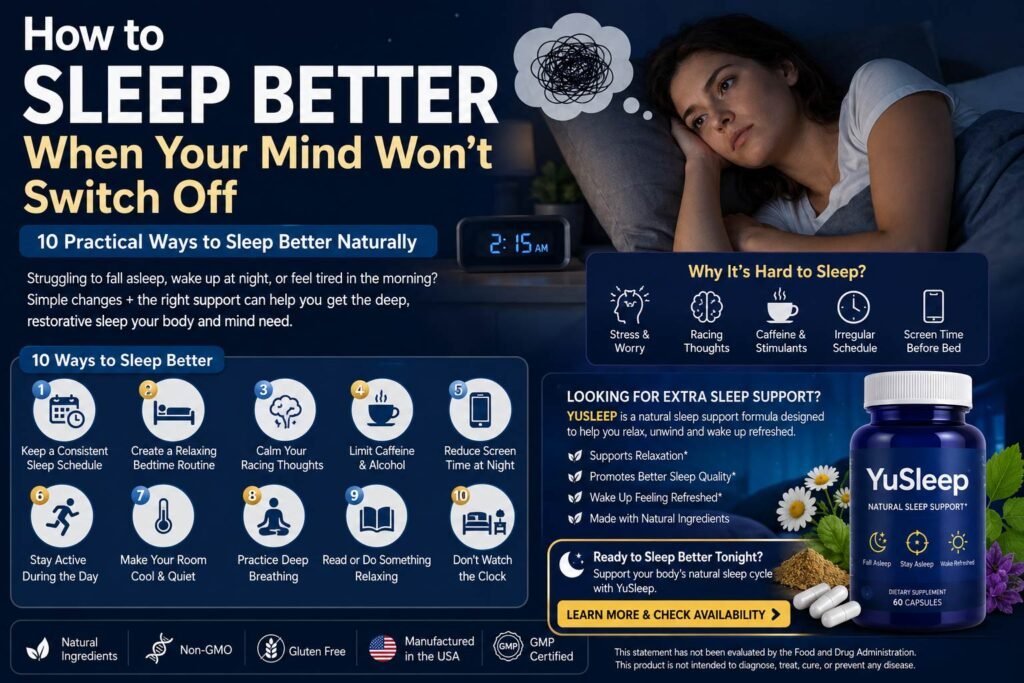
It’s late.
You’re tired.
Your body is ready for sleep.
But your mind has other plans.
You start thinking about tomorrow’s work.
Then a conversation from earlier comes back to you.
Then you remember something you forgot to do.
You check the time.
12:47 AM.
You tell yourself:
“I need to sleep.”
But somehow that thought makes falling asleep even harder.
If you’ve ever experienced this, you’re not alone.
Many adults struggle with falling asleep, staying asleep, or waking up feeling rested. Sleep problems can be connected with stress, changing schedules, caffeine, screen exposure, environmental factors and other issues.
The good news is that improving sleep doesn’t always start with buying a sleep product.
Sometimes the most useful first step is understanding what may be interfering with your sleep and changing a few habits consistently.
And for people who have already improved their sleep routine but are still interested in additional wellness support, sleep-support supplements are another category worth researching carefully.
First: How Much Sleep Do Adults Actually Need?
For most adults, a healthy target is generally at least seven hours of sleep per night, although individual needs can vary. The American Heart Association describes 7–9 hours as the recommended range for adults, while the National Heart, Lung, and Blood Institute emphasizes giving yourself enough time to sleep.
The important point is not simply the number of hours.
Sleep quality matters too.
You can spend eight hours in bed but still wake up repeatedly throughout the night.
That’s why improving your sleep routine should involve both:
Sleep duration + sleep quality.
Why Is It So Hard to Fall Asleep?
There isn’t one universal reason.
Your sleep can be affected by many things.
Common contributors include:
- Stress
- Worry
- Irregular sleep schedules
- Caffeine
- Alcohol
- Nicotine
- Excessive screen use at night
- An uncomfortable bedroom
- Late meals
- Daytime inactivity
- Frequent naps
- Certain medications
- Medical conditions
- Sleep disorders
The NHLBI notes that stress and worrying about work, relationships, money or other concerns can increase the risk of insomnia. It also notes that watching the clock and worrying about getting enough sleep can make insomnia worse.
That last point is especially interesting.
Sometimes the fear of not sleeping becomes part of the problem.
1. Keep the Same Sleep Schedule
One of the simplest changes you can make is also one of the most important:
Try to go to bed and wake up around the same time every day.
That includes weekends.
Your body operates on a sleep-wake rhythm.
Constantly changing your schedule can make it harder for your body to know when it should feel sleepy.
The NHLBI recommends maintaining a consistent sleep schedule and keeping the difference between weekday and weekend schedules relatively small.
You don’t need to create an unrealistic schedule.
Start with something you can actually maintain.
For example:
10:30 PM → bedtime
6:30 AM → wake-up
Then try to keep that schedule reasonably consistent.
2. Stop Treating Your Bed Like an Office
Your brain can learn associations.
If you regularly:
- Work in bed
- Watch stressful news in bed
- Scroll social media for hours
- Answer work emails
- Pay bills
- Have arguments
- Watch intense videos
your bedroom may become associated with alertness rather than relaxation.
Try to make your bedroom primarily a place for:
sleep and relaxation.
If you work from home, creating a separate workspace—even a small one—can help create a clearer psychological boundary between work and rest.
3. Create a 30-Minute Wind-Down Routine
Instead of going directly from:
Work → phone → bed → sleep
create a transition period.
For example:
30 minutes before bed
Put your phone away.
Dim the lights.
Take a warm shower.
Read a physical book.
Do gentle stretching.
Practice slow breathing.
Listen to something relaxing.
The NHLBI recommends using the hour before bed for quiet time and avoiding bright artificial light and stimulating activities.
You don’t have to copy someone else’s perfect routine.
Build a routine that you can repeat.
4. What If Your Mind Is Racing?
This is one of the most common frustrations.
Your body is tired.
Your mind keeps producing thoughts.
Instead of trying to force yourself to “stop thinking,” try giving those thoughts somewhere to go.
Try a simple brain-dump exercise.
Take a piece of paper.
Write down:
Tomorrow’s tasks
Things you’re worried about
Things you need to remember
Questions you want to handle tomorrow
Then close the notebook.
The American Heart Association recommends preparing for the next day and writing down to-do items as one way to help get those thoughts out of your head before bed.
The objective isn’t to solve everything at midnight.
It’s simply to remind yourself:
“I don’t have to solve this right now.”
5. Be Careful With Caffeine
That afternoon coffee might not seem important.
But caffeine can remain active in your system for hours.
If you already struggle with sleep, experiment with reducing caffeine later in the day.
This includes:
- Coffee
- Energy drinks
- Certain teas
- Pre-workout products
- Some soft drinks
- Other caffeinated products
The NHLBI recommends avoiding caffeine close to bedtime as part of healthy sleep habits.
You don’t necessarily need to eliminate caffeine completely.
Instead, pay attention to timing.
6. Make Your Bedroom Sleep-Friendly
Your bedroom environment matters.
Try to make it:
Cool
Avoid an environment that feels uncomfortably hot.
Dark
Reduce unnecessary light.
Quiet
Minimize disruptive sounds where possible.
Comfortable
Your mattress, pillow and bedding should support comfortable sleep.
The NHLBI recommends a bedroom that is cool, quiet and dark.
Small environmental changes can sometimes make a surprisingly big difference.
7. Don’t Keep Checking the Clock
This sounds harmless.
But imagine this:
11:45 PM
“I have plenty of time.”
Then:
12:15 AM
“Why am I not asleep?”
Then:
12:45 AM
“I only have six hours left.”
Then:
1:30 AM
“Tomorrow is going to be terrible.”
Now you’re not only awake.
You’re worried about being awake.
The NHLBI specifically notes that worrying about whether you’ll get enough sleep and watching the clock can contribute to insomnia.
If checking the time makes you more anxious, consider turning the clock away from your direct view.
8. Get Regular Physical Activity During the Day
Your body needs movement.
Regular daytime physical activity can support healthy sleep habits.
The important word here is:
daytime.
The NHLBI recommends regular physical activity and notes that exercising too close to bedtime may make it harder for some people to fall asleep.
You don’t necessarily need an expensive gym membership.
Try:
- Walking
- Cycling
- Swimming
- Yoga
- Strength training
- Recreational sports
Choose something you’ll actually enjoy doing consistently.
9. Be Careful With Late-Night Alcohol
Some people feel sleepy after drinking alcohol.
But falling asleep isn’t the same thing as getting good-quality sleep.
The NHLBI advises avoiding alcohol close to bedtime because it can contribute to lighter, more disrupted sleep.
So if you’re using alcohol as a way to fall asleep, it may be worth discussing healthier alternatives with a healthcare professional.
10. Don’t Ignore Persistent Sleep Problems
This is perhaps the most important part of this article.
If you occasionally have a bad night, that doesn’t automatically mean you have insomnia.
But persistent sleep problems deserve attention.
The NHLBI describes chronic insomnia as difficulty sleeping at least three nights per week for more than three months that isn’t fully explained by another health problem.
If you’re consistently:
- Struggling to fall asleep
- Waking repeatedly
- Waking too early
- Feeling exhausted during the day
- Having difficulty concentrating
- Depending on sleep aids regularly
talk with a healthcare professional.
For long-term insomnia, CBT-I (cognitive behavioral therapy for insomnia) is generally recommended as a first treatment option.
What About Natural Sleep Supplements?
Once you’ve worked on your basic sleep routine, you may start looking at natural sleep supplements.
This is where it’s important to slow down.
“Natural” doesn’t automatically mean:
safe for everyone
or:
effective for everyone.
Supplements can contain different combinations of herbs, amino acids, vitamins and other compounds.
One product currently marketed in the sleep-support category is YuSleep.
What Is YuSleep?
YuSleep is marketed as a sleep-support formula containing a combination of ingredients associated with relaxation and sleep-related pathways.
One YuSleep ingredient page currently lists:
- Red tart cherry extract
- 5-HTP
- L-theanine
- GABA
- Vitamin B6
- Vitamin B12
- Melatonin
Another current YuSleep product page lists a formulation containing ingredients including magnesium glycinate, lemon balm and apigenin, in addition to melatonin and other ingredients.
Because the online YuSleep pages currently show different formulations, anyone considering the product should check the exact label and Supplement Facts panel for the offer they are purchasing.
That’s a much better approach than relying on an old review or screenshot.
What Does Melatonin Do?
Melatonin is probably the best-known ingredient in many sleep supplements.
Your body naturally produces melatonin and uses it as part of the sleep-wake cycle.
Supplemental melatonin has been studied for certain sleep-related situations, but it isn’t appropriate to assume that more is better or that it works the same way for everyone.
The important distinction is:
Melatonin is associated with sleep timing.
It isn’t a universal solution for every reason someone may have trouble sleeping.
If you’re considering melatonin, particularly if you’re taking medication or have a medical condition, talk with your healthcare professional first.
What About L-Theanine?
L-theanine is an amino acid commonly associated with tea.
It’s included in some sleep and relaxation supplements.
The YuSleep ingredient page describes L-theanine as part of its relaxation-oriented formulation.
But ingredient-level research should not automatically be interpreted as proof that the entire YuSleep formula will produce a specific result.
That’s an important distinction when evaluating any supplement.
What About GABA?
GABA stands for gamma-aminobutyric acid.
It is an inhibitory neurotransmitter involved in the nervous system.
YuSleep includes GABA in its listed formulation.
The product’s marketing connects GABA with relaxation.
However, consumers should distinguish between understanding the biological role of an ingredient and having strong clinical evidence for a particular finished supplement.
What About 5-HTP?
5-HTP is another ingredient listed in YuSleep.
It is involved in the biochemical pathway related to serotonin production.
Because 5-HTP can interact with neurotransmitter pathways, this is one ingredient where you should be especially careful if you’re taking prescription medications.
Don’t assume a supplement is appropriate simply because it is sold without a prescription.
Ask your doctor or pharmacist if you take medications or have a medical condition.
So, Does YuSleep Work?
The responsible answer is:
Individual results can vary, and ingredient research does not automatically establish that the complete YuSleep formula will work the same way for everyone.
There is research on several ingredients used in sleep-support products, but evidence for an individual ingredient isn’t identical to evidence for a specific commercial formulation.
YuSleep should therefore be viewed as a dietary sleep-support option, not as a treatment or guaranteed solution for insomnia.
The foundation should remain:
Healthy sleep habits + appropriate professional guidance when necessary.
Who Should Be Cautious With Sleep Supplements?
Talk to a healthcare professional before starting a sleep supplement if you:
- Take prescription medication
- Take antidepressants
- Take sedatives
- Take other sleep products
- Are pregnant
- Are breastfeeding
- Have a chronic medical condition
- Have liver or kidney problems
- Have a history of medication interactions
- Are considering a supplement for a child
This is particularly relevant when a formula contains multiple active ingredients.
A Better Nighttime Routine You Can Try Tonight
Here’s a simple example.
8:30 PM
Finish demanding work.
9:00 PM
Reduce stimulating activities.
9:15 PM
Prepare clothes and tasks for tomorrow.
9:30 PM
Dim lights.
9:40 PM
Take a warm shower or bath.
9:50 PM
Read a book or practice relaxation.
10:15 PM
Get into bed.
10:30 PM
Lights out.
The exact time doesn’t matter.
Consistency does.
Your schedule should fit your lifestyle and the amount of sleep you need.
A Simple “Racing Mind” Exercise
If your mind won’t slow down, try this:
Step 1 — Write
Write down what’s bothering you.
Step 2 — Separate
Mark each thought as:
Can handle tomorrow
or
Needs action now
Step 3 — Close
Put the notebook away.
Step 4 — Breathe
Take slow, comfortable breaths.
Step 5 — Stop forcing sleep
You don’t need to command yourself:
“SLEEP NOW.”
Instead, focus on creating the conditions where sleep can happen naturally.
When Should You See a Doctor About Sleep?
Don’t rely only on online advice if your sleep problems are persistent.
Talk with a healthcare professional if:
- Sleep problems continue for weeks or months
- Daytime fatigue is affecting your life
- You frequently wake up gasping or choking
- You have loud persistent snoring
- You’re falling asleep unintentionally during the day
- You regularly need medication or supplements to sleep
- You suspect another health condition is affecting your sleep
A healthcare professional can help determine whether the issue is insomnia, another sleep disorder, medication-related, lifestyle-related or connected to another condition.
YuSleep: Is It Worth Researching?
If you’ve already started improving your sleep habits and you’re interested in exploring a supplement, YuSleep may be one product you come across.
Its listed ingredients include compounds such as melatonin, L-theanine, GABA, 5-HTP and tart cherry extract.
But don’t look at a supplement as a replacement for healthy sleep habits.
Instead, evaluate it by asking:
- What are the exact ingredients?
- What are the amounts?
- How should it be used?
- Are there medication interactions?
- Is the current formula different from older versions?
- What does the refund policy say?
- Is the product appropriate for me?
That approach helps you make a more informed decision.
Final Thoughts
Getting better sleep isn’t always about finding a magic solution.
Sometimes it’s about changing several small things consistently.
Start with the basics:
Keep a regular sleep schedule.
Reduce caffeine later in the day.
Create a relaxing bedtime routine.
Keep your bedroom cool, dark and quiet.
Limit stimulating screen use before bed.
Exercise regularly during the day.
Don’t spend the entire night watching the clock.
And if you’re dealing with persistent insomnia, don’t try to solve everything yourself.
Professional guidance can make a major difference. For long-term insomnia, CBT-I is a well-established treatment approach.
If you’re also interested in researching a sleep-support supplement such as YuSleep, carefully review its current ingredients, serving information and safety guidance before deciding whether it’s appropriate for you.
👉 Check YuSleep Product Information
Learn More & Check Current Availability
Important: The link you supplied currently redirects to a different ClickBank offer, The Brain Song, rather than YuSleep. Please replace it with your correct YuSleep HopLink before publishing this article.
Frequently Asked Questions
How can I sleep better at night?
Start with a consistent sleep schedule, a quiet and dark bedroom, less caffeine near bedtime, regular daytime activity and a relaxing wind-down routine.
How can I fall asleep faster?
Reduce stimulation before bed, keep your schedule consistent, manage racing thoughts and create a relaxing sleep environment.
Why can’t I sleep when I’m tired?
Stress, worry, irregular schedules, caffeine, screen exposure, environmental factors and medical or sleep conditions can all contribute to difficulty sleeping.
How do I sleep when my mind is racing?
Try writing down tomorrow’s tasks and worries before bed, followed by a quiet relaxation routine.
Does caffeine affect sleep?
Yes. Caffeine can interfere with sleep, particularly when consumed close to bedtime.
Does exercise help sleep?
Regular daytime physical activity can support healthy sleep habits. Avoid exercising too close to bedtime if it makes it harder for you to sleep.
What is sleep hygiene?
Sleep hygiene refers to habits and environmental conditions that support healthy sleep, including consistent schedules, appropriate light exposure, a comfortable bedroom and a relaxing bedtime routine.
Is melatonin a sleeping pill?
Melatonin is a hormone involved in the body’s sleep-wake timing. Supplemental melatonin is used in some sleep-related situations, but it isn’t appropriate for everyone.
Is YuSleep safe?
Safety depends on the specific formulation and the individual. YuSleep products contain multiple active ingredients, and people taking medications or managing health conditions should consult a healthcare professional before use.
Can YuSleep cure insomnia?
It should not be presented as a cure or treatment for insomnia. It is marketed as a dietary sleep-support product, and individual results may vary.
How long does YuSleep take to work?
There is no timeframe that can be guaranteed for everyone. Follow the product’s current directions and discuss persistent sleep problems with a healthcare professional.
Can I take YuSleep with medication?
Because some YuSleep formulations contain ingredients such as melatonin and 5-HTP, people taking medications should ask a healthcare professional or pharmacist before using it.
Should I use a sleep supplement every night?
That depends on the specific product and your individual situation. Don’t assume that long-term use is appropriate without professional guidance.
What if I keep waking up during the night?
Frequent nighttime awakenings can have many causes. If the problem persists or affects daytime functioning, speak with a healthcare professional.
When should I get help for insomnia?
If sleep difficulties persist and interfere with your daily life, professional evaluation is appropriate. Long-term insomnia may benefit from CBT-I.