
Best Web Hosting for WordPress in 2026: What Should You Actually Choose?
Choosing web hosting sounds simple.
You search for “best web hosting”, compare a few prices and choose the cheapest plan.
But that approach can create problems later.
Your hosting affects how your website is managed, how much storage you have, how many websites you can host, what backup options are available and how easily your website can grow.
For example, someone starting a small personal blog may only need one website.
A person running multiple affiliate websites may need hosting for several domains.
An ecommerce store may need more resources and more frequent backups.
So the real question isn’t:
“Which hosting company is the cheapest?”
The better question is:
“Which hosting plan matches my website?”
In this guide, we’ll look at the most important things you should consider before buying web hosting in 2026.
And if you’re looking for a hosting provider with WordPress support, backups, SSL, CDN and different plan options, we’ll also look at where Hostinger can fit into the decision.
🔥 Looking for an Affordable Hosting Plan?
If you’re ready to compare Hostinger’s current plans, you can check the official pricing page here:
👉 Get Up to 20% OFF Hostinger Through This Referral Link
Hostinger’s official referral program currently states that referred customers can receive up to 20% off on eligible purchases.
Affiliate/referral disclosure: This is a referral link. We may receive a commission if you make an eligible purchase through the link, at no additional cost to you.
What Is Web Hosting?
Before choosing a hosting provider, let’s understand what web hosting actually does.
Your website consists of files, databases, images, code and other information.
These files need to be stored on a server connected to the internet.
Web hosting provides that environment.
When someone types your domain into a browser, the hosting server delivers your website’s content to that visitor.
Without hosting, your website doesn’t have a place to live online.
Think of it like this:
Domain = Your website address
Hosting = The space where your website lives
WordPress = The software used to build/manage the website
Understanding this difference makes choosing hosting much easier.
Why Cheap Hosting Isn’t Always the Best Choice
Price is important.
But price shouldn’t be the only deciding factor.
A very cheap hosting plan may have limitations involving:
- Number of websites
- Storage
- Backup frequency
- Performance resources
- Database capacity
- Customer support
- Website migration
Imagine buying hosting for a new affiliate website.
Initially, you may only have ten articles.
Six months later, you could have:
- 100+ articles
- Hundreds of images
- Multiple plugins
- Analytics
- Affiliate tracking
- Several landing pages
Your hosting requirements may have changed.
That’s why it’s better to choose a hosting plan based on current needs plus realistic future growth.
7 Things to Check Before Buying Web Hosting
1. How Many Websites Can You Host?
This is one of the first things to check.
If you only need one website, a single-site plan may be enough.
But if you’re planning multiple websites, you may want a plan supporting several or unlimited websites.
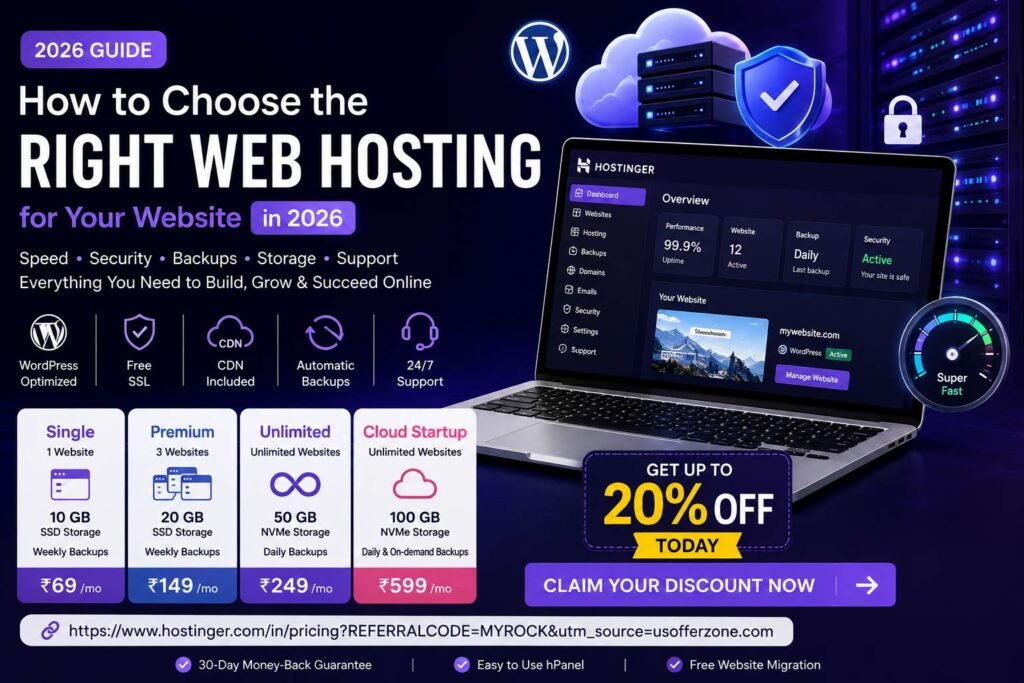
For example, Hostinger’s current pricing page lists:
- Single — 1 website
- Premium — 3 websites
- Unlimited — unlimited websites
- Cloud Startup — unlimited websites
This difference can become important if you’re managing several websites.
2. How Much Storage Do You Need?
Storage is another important consideration.
A simple blog may not require much storage.
But an image-heavy website, ecommerce store or content website can use considerably more space.
Hostinger’s current plans list:
Single: 10 GB SSD
Premium: 20 GB SSD
Unlimited: 50 GB NVMe
Cloud Startup: 100 GB NVMe
You shouldn’t automatically buy the plan with the largest storage.
Instead, think about what you’re actually going to store.
3. Does the Hosting Include Automatic Backups?
This is one of the most important questions.
A website can contain months or years of work.
If something goes wrong, a recent backup can give you a recovery point.
Hostinger’s current plans include different backup options depending on the plan.
The current pricing page lists:
- Single — free weekly backups
- Premium — free weekly backups
- Unlimited — daily backups
- Cloud Startup — daily and on-demand backups
If your website changes frequently, daily backups can be more useful than weekly backups.
For a small website that rarely changes, weekly backups may be sufficient for some users.
4. Does It Support WordPress?
If you’re building a WordPress website, make sure your hosting provider supports WordPress properly.
WordPress websites can be used for:
- Blogs
- Affiliate websites
- Business websites
- Portfolio websites
- News websites
- Ecommerce
- Online courses
- Membership websites
Hostinger’s current hosting plans list WordPress among the supported website technologies.
That makes it an option worth considering if WordPress is your preferred platform.
5. Is SSL Included?
SSL helps establish a secure HTTPS connection between your website and visitors.
You’ll notice this when a website starts with:
https://
rather than:
http://
For a modern website, HTTPS is important for security and visitor trust.
Hostinger currently lists SSL as included across its hosting offerings.
Still, after setting up a website, you should verify that your entire site is actually loading correctly through HTTPS.
6. Does the Hosting Include CDN?
A CDN, or Content Delivery Network, can help deliver website resources efficiently to visitors in different geographic locations.
This can be useful if your audience is spread across:
- United States
- Canada
- India
- United Kingdom
- Europe
- Australia
Hostinger currently lists CDN functionality with its web hosting plans.
However, don’t assume CDN alone will make every website fast.
Website performance also depends on:
- Images
- Plugins
- Theme
- JavaScript
- CSS
- Caching
- Database
- Website design
7. What Happens When Your Website Grows?
This is something beginners often overlook.
You may start with one website.
Then you create another.
Then another.
Eventually, you might be managing:
Blog + Affiliate Site + Business Website + Landing Page Website
If your hosting plan only supports one website, you may need to upgrade.
That’s why scalability matters.
Hostinger’s current higher-tier plans support multiple or unlimited websites, giving users more room to expand.
Shared Hosting vs Cloud Hosting
Another question you’ll eventually encounter is:
Should I use shared hosting or cloud hosting?
Let’s simplify it.
Shared Hosting
Shared hosting means your website operates in a hosting environment where resources are shared among multiple websites.
It can be suitable for:
- Beginners
- Small blogs
- Personal websites
- Small business websites
- Smaller affiliate sites
Cloud Hosting
Cloud hosting is generally designed to provide more resources and scalability.
It can be more suitable for:
- Growing websites
- Higher-traffic projects
- Ecommerce
- Agencies
- Resource-intensive websites
Hostinger currently positions Cloud Startup toward agencies and high-traffic projects and lists 100 GB NVMe storage, daily and on-demand backups, CDN and other features.
You don’t need cloud hosting simply because it’s more expensive.
Choose based on your actual requirements.
Which Hosting Is Best for a New WordPress Website?
If you’re starting your first WordPress website, you probably don’t need the biggest hosting package available.
A simple plan may be enough.
Focus on getting these basics right:
✔ WordPress support
✔ SSL
✔ Backup
✔ Enough storage
✔ Reliable support
✔ Room for growth
✔ Easy website management
The goal isn’t to buy the most expensive hosting.
The goal is to buy appropriate hosting.
Which Hosting Is Better for Affiliate Websites?
Affiliate websites can have different requirements from ordinary personal blogs.
An affiliate website may include:
- Product reviews
- Comparison pages
- Images
- SEO plugins
- Tracking scripts
- Multiple landing pages
- Email forms
- Analytics
- Affiliate links
If you’re building one small affiliate website, an entry-level plan may be enough.
If you’re building multiple affiliate websites, a plan supporting multiple or unlimited websites can be more practical.
If you’re publishing content frequently, backup frequency becomes more important too.
Hostinger: Where Does It Fit?
This is where Hostinger becomes interesting for many website owners.
Rather than offering only one hosting package, Hostinger currently provides different plans designed for different requirements.
Single
Best suited to beginners and simple projects.
Current listed features include:
- 1 website
- 10 GB SSD
- Weekly backups
- WordPress
- CDN
- AI tools
Premium
Designed for creators and small brands.
Current listed features include:
- 3 websites
- 20 GB SSD
- Weekly backups
- WordPress
- CDN
- AI tools
Unlimited
Designed for users wanting more flexibility.
Current listed features include:
- Unlimited websites
- 50 GB NVMe
- Daily backups
- CDN
- WordPress
- AI tools
- Ecommerce
Cloud Startup
Designed for agencies or higher-traffic projects.
Current listed features include:
- Unlimited websites
- 100 GB NVMe
- Daily and on-demand backups
- CDN
- WordPress
- Ecommerce
- AI tools
💡 A Simple Way to Choose
Instead of asking:
“Which Hostinger plan is best?”
Ask:
Do I need one website?
Consider Single.
Do I need a few websites?
Consider Premium.
Do I need multiple websites and daily backups?
Look at Unlimited.
Do I have a larger or high-traffic project?
Consider Cloud Startup.
This simple approach can prevent you from paying for features you don’t need.
What About Hostinger’s Current Discount?
This is one reason it can be worth checking the official pricing page before purchasing.
Hostinger’s official referral program currently says that people using a referral can receive up to 20% off, while the referrer can receive a reward for eligible purchases.
The exact discount and applicable terms can depend on the purchase and current offer.
So rather than relying on an old screenshot or outdated coupon page, check the current price shown at checkout.
👉 Check Hostinger Plans & Get Up to 20% OFF
This is an affiliate/referral link. If you make an eligible purchase through it, we may earn a commission at no additional cost to you.
What You Shouldn’t Ignore: Renewal Pricing
This is an important point when comparing hosting.
Don’t look only at the introductory monthly price.
Hostinger’s current pricing page shows both promotional pricing and renewal pricing for its plans. For example, the current page lists Single at ₹69/month on the displayed 48-month offer and ₹289/month on renewal; Premium at ₹149/month and ₹449/month on renewal; Unlimited at ₹249/month and ₹649/month on renewal; and Cloud Startup at ₹599/month and ₹1,599/month on renewal.
The displayed monthly price is based on the total price of the selected term rather than being a standalone monthly subscription.
Always check the renewal price before purchasing.
That’s a good rule for any hosting provider.
What About the 30-Day Money-Back Guarantee?
Hostinger’s pricing page currently displays a 30-day money-back guarantee.
That can provide additional flexibility when trying a hosting service.
However, always review the provider’s current terms and eligibility requirements before purchasing.
Is Hostinger Good for Beginners?
For beginners, simplicity matters.
You don’t want to spend your first week trying to understand complicated server configuration.
A beginner-friendly hosting environment can make it easier to:
- Install WordPress
- Manage domains
- Configure SSL
- Manage backups
- Create websites
- Manage email
- Monitor hosting
- Contact support
Hostinger currently advertises 24/7 support and website-building tools alongside its hosting plans.
Your experience will still depend on your website and technical requirements.
Is Hostinger Good for SEO?
Hosting alone doesn’t make a website rank.
That’s important to understand.
Your SEO performance depends on many factors:
- Search intent
- Content quality
- Technical SEO
- Website structure
- Page speed
- Internal linking
- Mobile usability
- Backlinks
- User experience
Good hosting can provide a strong technical foundation, but it cannot guarantee Google or Bing rankings.
Before You Buy Web Hosting: Final Checklist
Before clicking the purchase button, check these items:
☑ Number of websites
☑ Storage
☑ Backup frequency
☑ SSL
☑ CDN
☑ WordPress support
☑ Ecommerce requirements
☑ Renewal price
☑ Money-back policy
☑ Customer support
☑ Migration options
☑ Upgrade options
This checklist can help you compare hosting plans more objectively.
Final Verdict
The best web hosting isn’t necessarily the cheapest or the most expensive.
It’s the one that matches your website.
If you’re creating a basic WordPress website, you may not need a large cloud plan.
If you’re managing several websites, multiple-site hosting can be more convenient.
If your website changes frequently, automatic daily backups can become an important consideration.
And if your website is growing rapidly, you may eventually need more resources.
Hostinger is one option worth considering because its current plans combine features such as WordPress support, SSL, CDN, backups, AI tools and different website/resource limits across several tiers.
If you’re ready to compare the current plans, you can check the official pricing page below.
🚀 Get Up to 20% OFF Hostinger
👉 Check Hostinger Pricing & Claim Your Available 20% Discount
The Hostinger referral program currently states that referred customers can receive up to 20% off, subject to the applicable referral terms.
Affiliate Disclosure: This page contains a referral/affiliate link. If you purchase an eligible Hostinger service through our link, we may receive a commission at no additional cost to you.
Frequently Asked Questions
What is the best web hosting for WordPress?
There isn’t one hosting provider that is best for every website. Compare WordPress support, storage, backups, performance resources, pricing and scalability before choosing.
Is Hostinger good for WordPress?
Hostinger supports WordPress across its current web hosting plans and includes WordPress among its supported website technologies.
Does Hostinger provide automatic backups?
Yes. The backup frequency depends on the plan. Current plans list weekly backups on Single and Premium, daily backups on Unlimited and daily/on-demand backups on Cloud Startup.
Does Hostinger offer a 20% discount?
Hostinger’s official referral program currently states that referred customers can receive up to 20% off on eligible purchases.
Is the 20% discount available on every plan?
The exact discount and eligibility can depend on the current referral terms and purchase. Check the pricing page and checkout for the applicable offer.
Is Hostinger good for affiliate websites?
It can be suitable for affiliate websites. The appropriate plan depends on the number of websites, traffic, storage and backup requirements.
Should I choose daily or weekly backups?
If your website changes frequently, daily backups can provide more recent recovery points. For websites that rarely change, weekly backups may be sufficient for some users.
Is cheap hosting always better?
No. Look beyond price and compare features, resources, backups, support and renewal costs.
Does hosting guarantee Google rankings?
No. Hosting is only one part of your website’s technical foundation and cannot guarantee search rankings.